If you are planning to replace a missing tooth, your first question is usually straightforward: how much time will this actually take?
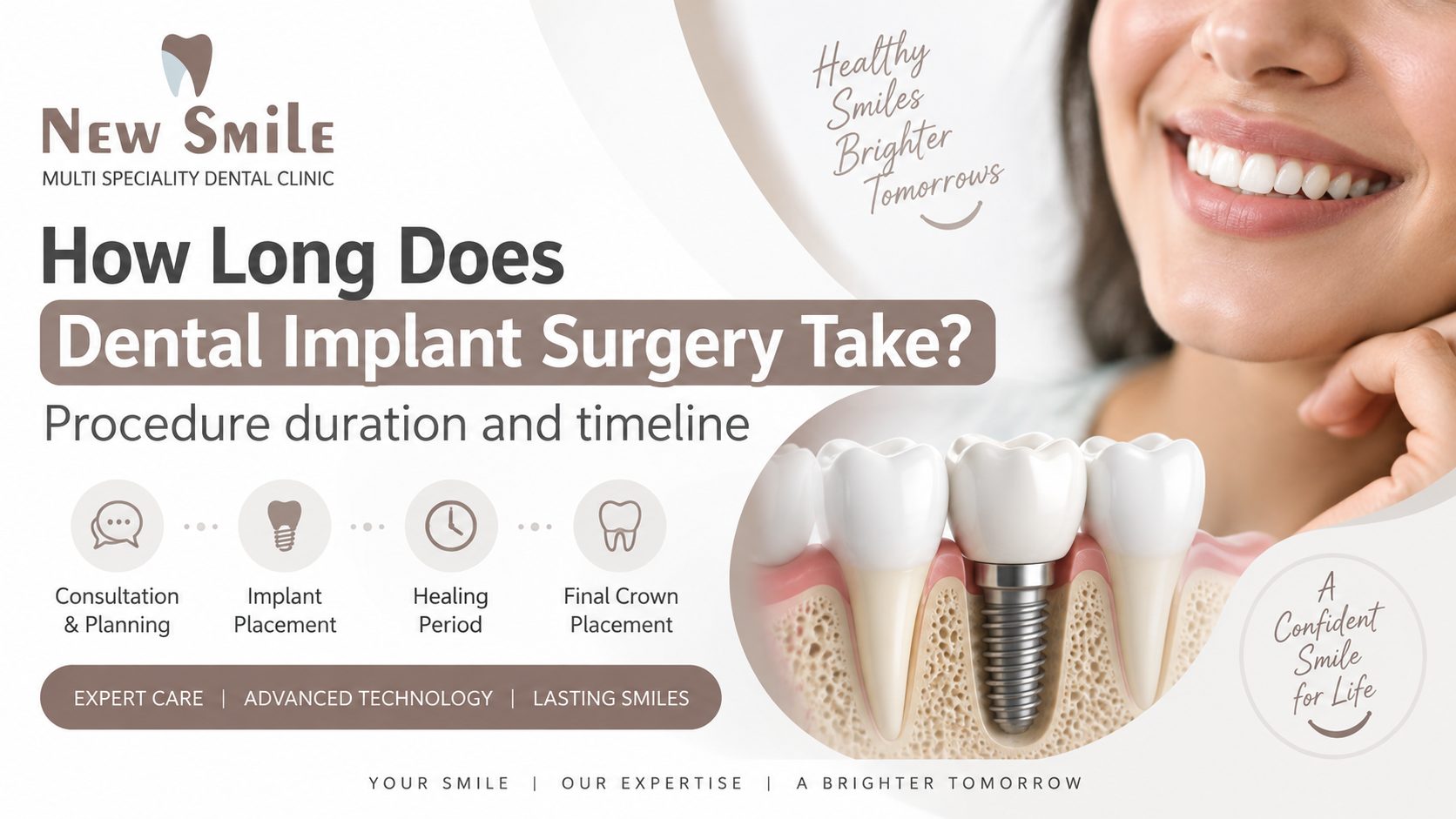
There are two parts to that answer. The surgical placement of a single dental implant takes only 30 to 60 minutes in the clinic chair. However, the complete process—from your first scan to walking out with a fully functional, permanent porcelain crown—spans 3 to 6 months. When bone grafting is needed first, that timeline can reach 6 to 9 months.
Let’s break down both timelines so you know exactly what happens on surgery day, week by week during recovery, and at every appointment in between.
At a Glance: Dental Implant Chair Time by Procedure
Here is what you can expect to spend in the dental operatory on the day of surgery:
| Procedure Type | Estimated Chair Time | Primary Focus |
|---|---|---|
| Single Dental Implant | 30 – 60 minutes | One titanium fixture placed in healthy, existing bone. |
| Multiple Implants (2–4 teeth) | 1.5 – 2.5 hours | Parallel placement for implant-supported bridges. |
| Full-Arch (All-on-4 / All-on-6) | 2.5 – 4 hours | Extraction of failing teeth, 4–6 implants, and temporary teeth fixed on the same day. |
| Implant with Bone Graft | 45 – 90 minutes | Bone augmenting material packed around the implant site. |
What Happens During the 45-Minute Surgery?
Many patients expect a lengthy, grueling ordeal. In practice, modern computer-guided implant surgery is quick, controlled, and minimally invasive. Here is how your appointment unfolds:
- Numbing and Preparation (10–15 minutes): Local anesthesia is administered around the site. We test the area thoroughly to ensure complete numbness before touching a single instrument.
- Site Preparation (10–15 minutes): A tiny, gentle incision is made in the gum tissue to expose the underlying jawbone. Using high-precision surgical drills and continuous saline cooling, a precise socket (osteotomy) is formed to match the exact diameter and length of the titanium post.
- Implant Insertion (5–10 minutes): The medical-grade titanium fixture is threaded into the prepared bone at a calibrated torque level to establish rock-solid primary stability.
- Closing the Site (5 minutes): A protective healing cap is placed over the implant, and one or two dissolvable stitches secure the gum tissue around it.
You rinse, receive your post-operative instructions, and walk out. Most patients are surprised at how quiet and painless the actual surgical step is.
The Complete Dental Implant Timeline (Month by Month)
While the surgical phase takes under an hour, biology requires time to lock the implant into place. Here is the step-by-step schedule from your first consultation to your final restoration:
Phase 1: Diagnostic Assessment & 3D Imaging (Day 1)
We take a high-resolution 3D CBCT scan alongside digital intraoral impressions. This scan gives us a cross-sectional view of your jawbone thickness, nerve canals, and sinus floors. By planning the exact angle and depth digitally before you sit in the chair, we cut your actual surgery time in half.
Phase 2: Preparatory Procedures (If Needed: +3 to 4 Months)
If the tooth has been missing for months or years, the jawbone naturally shrinks. If your bone height or density is inadequate, a bone graft or sinus lift is performed. In minor cases, grafting occurs during the implant surgery itself. If extensive grafting is needed, we wait 3 to 4 months for the bone graft to mature into solid, living bone.
Phase 3: Implant Placement (Surgery Day: 45 Minutes)
The implant post is inserted into the jawbone. This post functions as the artificial root of your new tooth.
Phase 4: Osseointegration & Healing (3 to 6 Months)
This is the most critical phase of the treatment. Osseointegration is the natural biological process where living bone cells attach and fuse directly to the microscopic ridges of the titanium implant. During this period:
- Lower jaw implants typically fuse in 3 to 4 months due to denser bone.
- Upper jaw implants typically take 4 to 6 months due to softer, more porous bone.
- You can wear a lightweight temporary tooth during this time so you never leave with an open gap in your smile.
Phase 5: Abutment Connection & Digital Scan (Week 14–16)
Once the bone fusion is verified with an X-ray, the gum is gently opened to attach the abutment—the connector post that joins the implant to the crown. We then take a 3D digital scan of the abutment to fabricate your custom crown.
Phase 6: Final Crown Delivery (2 Weeks Later)
Your permanent, custom-shaded zirconia or porcelain crown is attached and checked for bite balance, flossing contact, and aesthetic alignment. Once tightened, your new tooth is fully functional.
What Factors Change Your Timeline?
No two mouths heal at the exact same pace. Four key factors dictate whether your treatment takes 3 months or closer to 8:
- Bone Quality and Density: Dense native bone supports immediate stability. Thinned bone requires grafting, adding healing cycles.
- Immediate vs. Delayed Placement: In select cases with zero infection and thick bone, we can extract an unsalvageable tooth and place the implant in the exact same visit ("same-day implants"), shaving 2 to 3 months off your schedule.
- Systemic Health: Controlled blood sugar levels, adequate Vitamin D, and good cardiovascular health promote quick bone integration. Uncontrolled diabetes slows down cell turnover.
- Tobacco Use: Smoking constricts micro-capillaries in the gums, drastically reducing blood supply to healing bone and doubling the healing timeline.
What Does Recovery Look Like After Surgery?
Recovery is significantly faster than most people anticipate. Here is what the first few days feel like:
- First 24 Hours: Minimal bleeding controlled with a gauze pack. Apply an ice pack on the outside of your cheek in 15-minute intervals. Stick to cool, soft foods like yogurt, smoothies, and dal khichdi.
- Days 2 to 3: Peak mild swelling. Discomfort is easily handled with prescribed analgesics. Most patients with single implants return to office work by day 2.
- Days 7 to 10: Soft tissues heal over the collar. Sutures are either removed or dissolve on their own.
- Weeks 2 to 12: You feel completely normal. The implant is quietly fusing underneath without any sensation.
Frequently Asked Questions
Does getting a dental implant hurt?
No. The jawbone has very few pain-sensing nerve endings. With standard local anesthesia, you feel pressure and gentle vibration, but zero sharp pain. Most patients report that an extraction is far more uncomfortable than placing an implant.
Can I get teeth in a single day?
Yes, under specific criteria. With immediate loading (often used in full-arch All-on-4 treatments), temporary fixed teeth are attached within 24 hours of surgery. However, the underlying titanium implants still require 3 to 4 months of gentle care to fully fuse with the bone before final permanent teeth are fitted.
How long do I need to take off work?
For a single implant, taking the day of surgery off is usually enough. For complex cases involving multiple teeth or extensive bone grafting, planning 2 to 3 days of rest gives your body the best start for swelling control.
Get an Accurate, Guided Assessment at New Smile
Knowing your exact timeline starts with a clear look at your bone structure. At New Smile Dental Clinic, our implant specialists use advanced 3D CBCT digital imaging to map your treatment before surgery day—minimizing your chair time and giving you a clear, transparent schedule from day one.
Ready to restore your smile? Book your implant consultation at New Smile today to get a personalized treatment plan.